
How to Set Up Co-ordination Training at Home: Equipment and Drills
You don't need a gym membership, a dedicated training facility or a cupboard full of equipment to start exploring co-ordination training at home.
With a ball, a few training markers and enough clear space to move, you can create a simple setup for practising hand-eye coordination, footwork, balance, timing and reaction. A home coordination training setup can work for athletes looking to supplement their sport-specific practice, families wanting more active play, or anyone interested in adding variety to their movement routine. The best part? You can keep it simple, adapt the exercises to your ability and change the challenges whenever you want something different.
Here's how to build your own setup and make the most of the equipment you have.

What Equipment Do You Need for Co-ordination Training at Home?
You can get started with just a few basics. The aim is to choose versatile tools that allow you to practise different movement patterns without needing a large amount of space.
1. Balls
Balls are the foundation of many hand-eye coordination exercises.
You can use them for throwing and catching, bouncing, hand transfers, partner passing and drills that combine ball control with footwork.
Start with a ball that is comfortable to hold and catch. If you have several suitable balls, you can eventually experiment with multi-ball exercises.
Consider what you'll be practising and choose equipment that suits your intended use and training surface.
2. Flat Training Markers
Markers help create a structure for your training area.
You can place two markers apart for lateral movement, arrange several in a line for weaving drills or position four in a diamond for directional reaction exercises.
They're easy to rearrange, making them useful when you want to change an exercise without purchasing additional equipment.
Markers can also provide visual targets for individual and partner challenges.
3. Clear Space
You don't need a huge training area, but you do need enough room to move safely.
A backyard, suitable driveway, clear garage area or open section of a park may work, depending on the activity and surface.
Before you begin:
-
Remove objects that could cause trips or falls.
-
Check that the surface is suitable for the movements you're practising.
-
Allow enough room to throw, catch and move without hitting nearby objects.
-
Keep other people and pets clear of the exercise area.
-
Avoid throwing balls towards windows, vehicles or other fragile objects.
For outdoor sessions, consider the surface, weather conditions and available space before choosing your drills.
4. A Training Partner (Optional)
A partner can introduce another level of variety, but you don't need one for every exercise.
Training alone? Practise alternating ball tosses, under-the-leg transfers, marker weaves and self-directed movement patterns.
Training with someone else? Add partner passing, call-and-react drills and challenges where each person creates a sequence for the other to follow.
Both options can work within the same home training setup.

How to Arrange Your Home Coordination Training Area
Once you have your equipment, start with a simple layout. Place two markers a few steps apart and use the space between them for ball and footwork drills. If you have four markers, arrange them in a diamond to practise changing direction. Keep your balls within easy reach so you can move between exercises without interrupting your session.
You can change the marker layout depending on the activity. A straight line might suit a weaving drill, while a diamond works well for multi-directional movements. You don't need to leave the setup permanently in place. One of the benefits of portable coordination training equipment is being able to pack it away when you're finished.
Five Co-ordination Exercises to Try at Home
These exercises provide a starting point for building variety into your home training sessions.
1. Alternating Ball Toss
Stand with your feet comfortably apart and toss a ball between your hands.
Focus on a controlled throw and catch, keeping the movement consistent.
Once comfortable, try changing the height of the toss or starting with your non-dominant hand.
What it challenges: Hand-eye coordination, timing and ball control.
2. Marker Weave and Catch
Arrange four to six markers in a line with enough room to move between them.
Weave through the markers while tossing a ball from one hand to the other.
Begin slowly so you can focus on both the ball movement and your footwork. If the combination feels too difficult, practise the weave and the ball toss separately before combining them.
What it challenges: Footwork, hand-eye coordination and movement control.
3. Lateral Movement and Catch
Place two markers several steps apart.
Move sideways between them while tossing a ball to yourself or receiving controlled passes from a partner.
Focus on maintaining your balance and keeping the ball movement controlled.
What it challenges: Lateral movement, balance and upper- and lower-body coordination.
4. Under-the-Leg Ball Transfer
Stand in a comfortable position and transfer a ball underneath one raised leg, catching it with the opposite hand.
Alternate sides and aim for a smooth rhythm.
Once you understand the pattern, introduce a slow marching movement.
What it challenges: Timing, body awareness and coordination between different movements.
5. Call-and-React Marker Drill
Arrange four markers around a central starting point.
Ask a partner to call one of the markers. Move towards the selected marker and return to the centre.
Once comfortable, introduce a ball pass after each movement.
If you're training alone, choose a marker sequence in advance and practise changing the direction between repetitions.
What it challenges: Direction changes, movement planning and response to cues.
These exercises can be adjusted to suit different abilities and experience levels. Start with manageable movements and only increase the complexity when you feel comfortable.

How Long Should You Spend on Home Coordination Training?
There's no single session length that suits everyone.
If you're new to these exercises, begin with a short session that gives you enough time to learn the movement patterns without feeling rushed. Choose three to five drills, practise each one for a comfortable period and take breaks as needed. For example, you might start with a ball toss, progress to a marker weave and finish with a partner reaction drill.
If you're an athlete, you can adapt the exercises to complement your existing training. If you're using the setup for family activities, you might prefer shorter rounds and playful challenges. Focus on movement quality and enjoyment rather than trying to complete as many repetitions as possible.
How to Make Your Home Coordination Workouts More Challenging
Once a drill becomes familiar, change one element rather than replacing the entire exercise.
Try these progressions:
-
Change hands: Begin the exercise with your non-dominant hand.
-
Change direction: Reverse the marker pattern.
-
Add footwork: Introduce walking or lateral movement to a stationary ball drill.
-
Add a reaction cue: Ask a partner to call a direction.
-
Introduce another ball: Explore more complex patterns when the basic movements are comfortable.
-
Change the sequence: Combine two familiar drills into one movement pattern.
You can also create a game by asking a partner to invent a sequence for you to copy.
These simple adjustments can make the same equipment useful across many sessions.
Common Home Training Mistakes to Avoid
Buying too much equipment too soon. Start with versatile tools and add specialised equipment only when you know what you need.
Making exercises too difficult too quickly. Learn the basic movement first, then introduce additional tasks gradually.
Focusing only on speed. Fast movements aren't always better. Controlled, repeatable movements are a useful starting point.
Ignoring the training environment. Make sure the surface and surrounding space suit the activity.
Repeating the same drill without variation. Changing the direction, rhythm or instructions can introduce new challenges without requiring new equipment.
A good home setup should be practical, adaptable and easy to use consistently.
Can You Build a Home Setup With One Training Kit?
Yes. A suitable coordination training kit can bring several useful tools together and remove some of the guesswork when getting started.
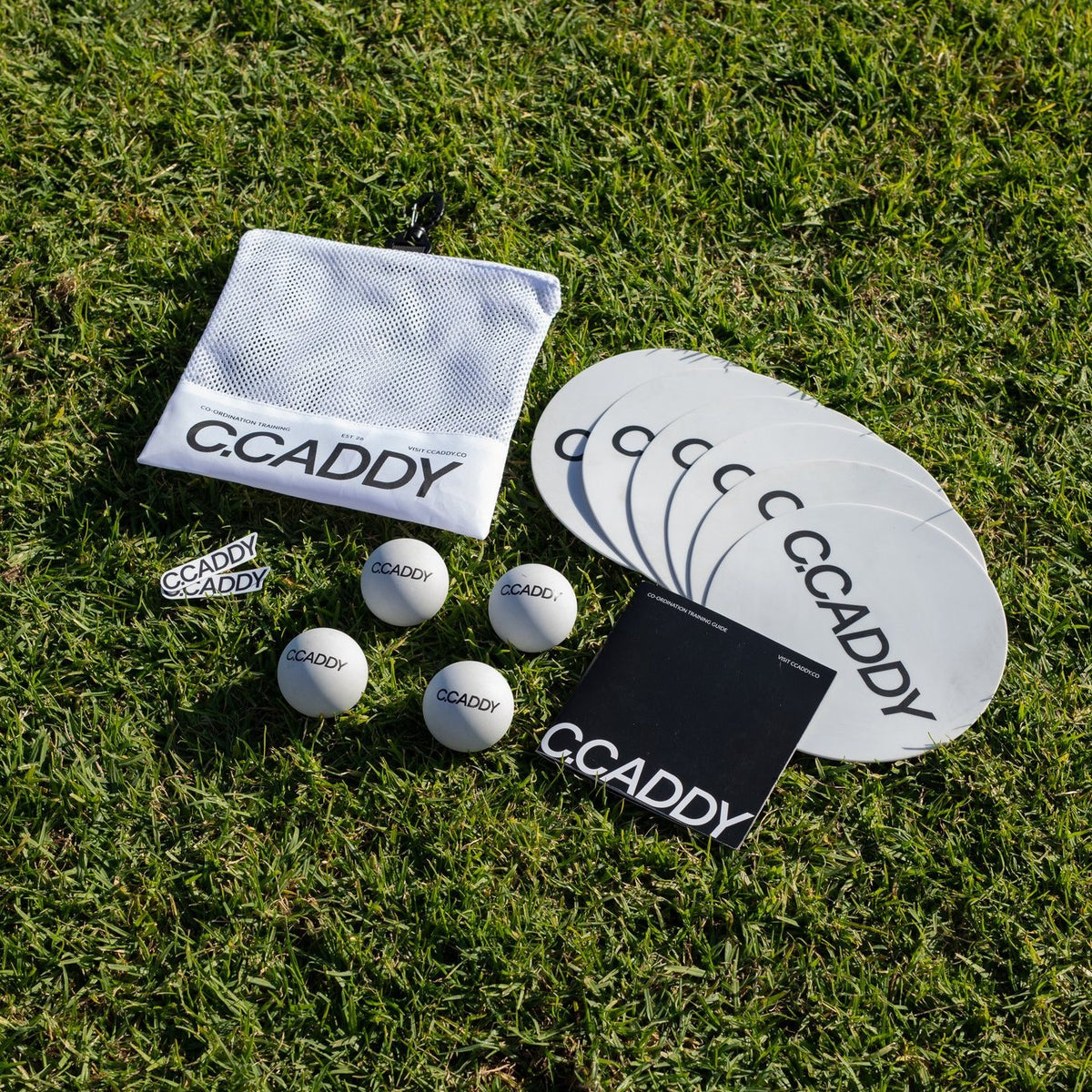
The C.CADDY Co-ordination Kit includes:
-
Four rubber balls
-
Six flat training markers
-
A 24-page Training Guide
-
QR access to video tutorials in the Training Vault
-
A carry bag
The balls and markers can be used together for a variety of individual, partner and movement-based exercises.
You could set up a marker weave in your backyard, practise ball transfers in an open space or ask a partner to create a call-and-react challenge. The Training Guide and video tutorials offer exercise ideas to help you explore different patterns and variations. Rather than buying balls and markers separately, the kit provides these core tools together in one portable setup. It's designed for athletes, coaches, families and everyday movers who want to explore co-ordination training at home, in the park or during structured training sessions.

Build Your Home Co-ordination Training Setup With C.CADDY
Getting started doesn't need to be complicated.
Choose a suitable ball, arrange a few markers and create enough clear space to move. Begin with simple exercises, introduce new challenges gradually and experiment with different ways to combine your movements.
If you'd prefer to have the basics together in one place, the C.CADDY Co-ordination Kit offers a practical starting point.
Four balls. Six markers. Endless ways to explore movement.
Explore the C.CADDY Co-ordination Kit and bring more co-ordination, balance, reaction and play into your home training.
Read more
Juggling is often seen as a party trick or a skill reserved for performers, but it can also be an engaging way to practise co-ordination. Whether you're an athlete looking for a new training challe...
Boxing training doesn't always have to follow the same routine. While technical drills, pad work, bag work and conditioning are important parts of a boxing program, introducing games and movement c...