
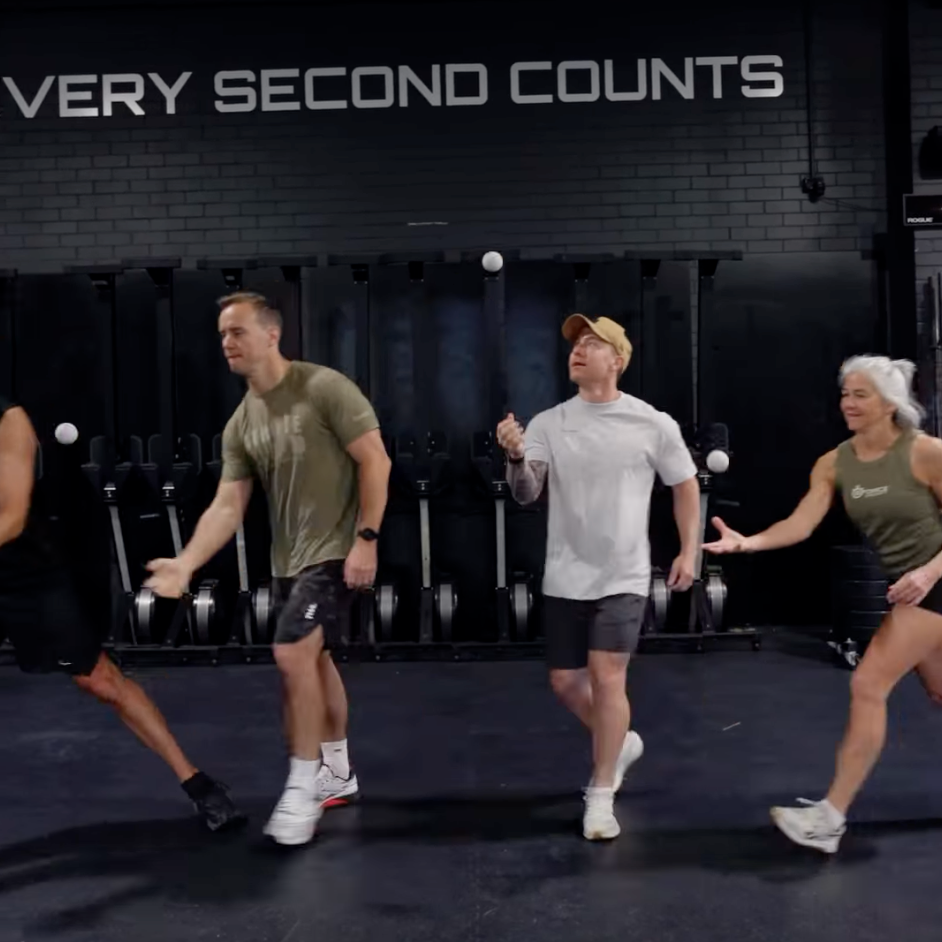
10 Partner Hand-Eye Co-ordination Drills
Training by yourself gives you control. Training with another person takes some of that control away, and that's exactly what can make it fun.
A partner can change the timing, direction and speed of a ball. They can call instructions, create distractions and turn a simple catching exercise into a reaction challenge. Here are 10 partner hand eye coordination drills you can try with a teammate, friend, coach or family member.

Why train with a partner?
Solo co-ordination drills can be highly predictable.
You throw the ball, so you know when it's coming.
A partner can introduce uncertainty.
You may have to watch their movement, respond to a cue or react to a ball being released unexpectedly.
That makes partner work an easy way to combine hand-eye co-ordination exercises and reaction drills.
1. Partner Drop Catch
One person holds a ball at approximately shoulder height while their partner prepares underneath.
Release the ball without a countdown.
The receiving partner reacts and catches it before it gets away.
Swap roles.
Progression: Change the starting hand or position.
2. Alternating Partner Toss
Stand opposite each other with one ball.
Pass the ball back and forth, alternating the hand used to throw and catch.
Once the pattern becomes comfortable, increase the speed or introduce a second ball.
3. Two-Ball Simultaneous Pass
Both partners start with a ball.
Pass both balls at the same time.
You can begin by throwing directly to the opposite hand, then introduce different heights or crossing patterns.
Communication helps, at least until you decide to turn it into a competition.
4. High-Low Catch
The throwing partner alternates between higher and lower passes.
The receiving partner doesn't know which is coming next and must adjust their position accordingly.
Keep the throws controlled and suitable for your partner.
5. Call & Catch
Place different coloured or numbered markers on the ground.
As the ball is thrown, the partner calls a marker.
The receiving athlete catches the ball and then moves towards the nominated marker.
This combines catching with listening, decision-making and movement.
6. Blind Start Catch
The receiving partner begins facing away.
The throwing partner gives a verbal cue.
On the cue, the receiver turns, locates the ball and completes the catch.
Start with gentle, easy-to-locate throws.
7. One-Hand-Only Challenge
Choose a hand.
That's the only hand the receiver can use.
Complete a set number of catches before switching sides.
This is an easy way to give the non-dominant side more attention.
8. Lateral Movement Passing
Place two markers on the ground.
Both partners move laterally while continuously passing the ball.
Keep the movement slow initially and focus on maintaining control.
Once you're comfortable, increase the pace.
9. Double-Ball Reaction Pass
Introduce two balls.
The throwing partner decides which ball to release first.
The receiving partner needs to identify the movement and respond.
As you progress, experiment with different throwing patterns.
10. Partner Challenge Circuit
Combine several exercises.
For example:
10 alternating catches
10 lateral passes
10 drop catches
10 non-dominant catches
30 seconds of two-ball passing
Keep score or simply see how cleanly you can complete the circuit.

How do you progress partner drills?
Good partner hand eye coordination drills don't necessarily need to become faster every time.
Try changing:
The number of balls
Distance between partners
Throwing hand
Catching hand
Direction
Starting position
Movement pattern
Type of cue
Number of markers
Predictability
Changing one variable can create an entirely different challenge.
Partner training for athletes and teams
These exercises can work particularly well in group environments because athletes can pair up and rotate through different stations.
Coaches might incorporate them into a warm-up or create short challenges between teammates.
Because a partner controls part of the drill, there's also room to introduce more reactive elements than you'd get from completely self-directed exercises.
Partner training for everyday movers
You don't need to play competitive sport either.
Grab a friend, partner, sibling or family member.
Part of the C.CADDY philosophy is bringing more play into movement.
A five-minute catching competition absolutely counts.
What do you need?
Most of these drills require only:
A suitable ball
A partner
A safe, clear space
Flat training markers can be added when you want to incorporate movement and direction.
The C.CADDY Co-ordination Kit includes four rubber balls and six markers, which makes it possible to progress from simple one-ball partner exercises into multi-ball and movement challenges.
You'll also find dedicated Partner & Team drills inside the C.CADDY Training Vault.
Training is better when it's shared
There are plenty of ways to work on co-ordination alone. But sometimes another person is the missing ingredient. They make things less predictable. They challenge you. They probably laugh when you drop the easiest catch of the day. And that's part of it.
Grab a partner, choose a drill and put your co-ordination to the test.
Read more
Developing hand-eye co-ordination is an important part of learning how to move, play and interact with the world. From catching a ball and throwing to a target to participating in team sports, kid...
CrossFit competitions are known for testing athletes across a range of physical challenges. From heavy barbell lifts to high-intensity conditioning, competitors are required to demonstrate strengt...