
How to Train Hand-Eye Co-ordination with C.CADDY
If you've ever tried to catch something unexpectedly thrown towards you, juggle multiple balls or learn a new ball skill, you'll know how quickly a seemingly simple movement can become a challenge.
Hand-eye co-ordination is involved in many sporting and training activities, but it doesn't need to be something you only think about while playing your chosen sport.
If you're wondering how to improve hand eye coordination, the starting point can be surprisingly simple: create opportunities to track, react and move, then progressively make those tasks more challenging.

What is hand-eye co-ordination?
Hand-eye co-ordination broadly describes the use of visual information to guide hand movements.
Catching a ball is an easy example.
Your eyes provide information about where the ball is travelling, while your body needs to organise an appropriate movement to meet it.
Add speed, another ball, movement or an unpredictable partner and the task becomes considerably more challenging.
This connection between visual information and movement is often described as visuomotor coordination. In sport, efficient visual-motor responses are particularly relevant when athletes need to respond to moving objects and changing environments.
How do you train hand-eye co-ordination?
There's no single hand-eye co-ordination exercise that does everything.
Instead, think about gradually introducing different types of challenges.
Start with tracking
Before making a drill complicated, practise following the movement of a ball.
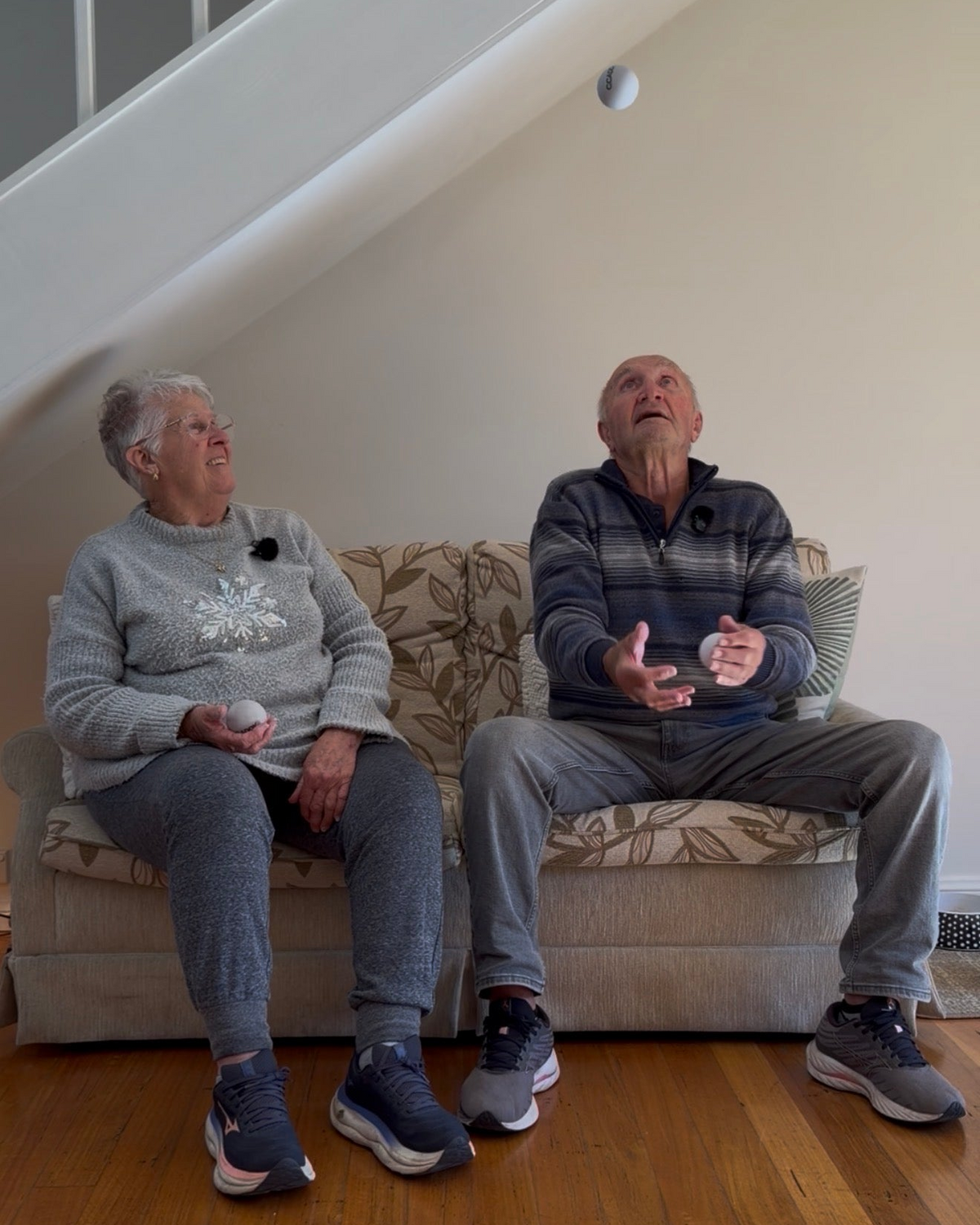
Toss a ball from one hand to another or against a wall and focus on maintaining control.
Add catching
Throw, bounce or rebound the ball and catch it.
Vary the height, angle and hand being used.
Introduce your non-dominant hand
If you always use your preferred hand, simply switching sides can turn an easy exercise into a new challenge.
Add another ball
One ball becomes two.
Two can eventually become three or four.
Multi-ball exercises require you to manage more information and coordinate multiple movements.
Add body movement
Once the catching component is manageable, add footwork, balance or directional movement.
Flat markers are useful here because they allow you to create simple movement patterns.
Introduce unpredictability
Predictable drills are useful when learning a movement.
But a partner can add an entirely different challenge because you may not know exactly where or when the next throw is coming.
That can make partner drills particularly useful for combining hand-eye co-ordination and reaction training.

Try simple ball exercises
You don't need expensive hand eye coordination equipment to get started.
Try:
Single-hand toss and catch
Alternating hand tosses
Wall tosses
Bounce catches
Under-the-leg tosses
Two-ball exercises
Partner catches
Ball drops
Movement and catch combinations
The important part is finding a challenge appropriate to your current ability.
Progress instead of jumping straight to advanced drills
It's tempting to see an impressive four-ball drill online and immediately try to copy it.
Sometimes that's fun.
But progression can make training easier to understand.
For example:
Level 1: Toss one ball and catch with the same hand.
Level 2: Toss and catch with the opposite hand.
Level 3: Add a movement between the toss and catch.
Level 4: Introduce a second ball.
Level 5: Add footwork.
Level 6: Introduce a partner or unpredictable cue.
One basic exercise has now become six different hand eye coordination drills.
How often should you train?
There isn't one universal schedule for hand-eye co-ordination training.
It can be incorporated into what you're already doing.
You might add a few minutes of ball drills before a gym session, include co-ordination exercises in a sporting warm-up or create a dedicated session.
Consistency and appropriate progression are generally more useful concepts than trying to make every session long or extremely difficult.

Hand-eye co-ordination for sport
For athletes, hand-eye demands can differ enormously between sports.
A cricket player responding to a ball, a goalkeeper reacting to a shot and a tennis player tracking an opponent's return are completing very different tasks.
This is why general hand-eye coordination training for athletes should complement rather than replace sport-specific practice.
Research into sports vision and visuomotor training supports the relevance of visual processing and motor responses in sporting environments, although transfer from a particular training exercise to competitive performance depends on the task and training method.
Do you need electronic equipment?
Not necessarily.
Technology can create useful reaction and visual training environments, but traditional equipment can also be used to create visual-motor challenges.
Balls, markers, walls, partners and movement cues can all form part of co-ordination and reaction training.
The question isn't necessarily, "What's the most complicated equipment?"
It's:
What can I actually do with it?
Making hand-eye training enjoyable
One reason we love co-ordination training at C.CADDY is that it can feel like play. Set yourself a challenge. See how many catches you can complete. Try your non-dominant hand. Challenge a friend. Add another ball. Make up a new pattern.
Training doesn't always need to feel like another set of reps.

Start where you're at
If you're learning how to improve hand eye coordination, don't worry about starting with the most advanced drill.
Start with something manageable.
Build control.
Then change one variable at a time.
The C.CADDY Co-ordination Kit was created around this exact idea, combining four balls, six markers, a Training Guide and access to our Training Vault so you have both the equipment and somewhere to start.
Start simple. Keep progressing. And don't worry about the drops — they're part of it.
Read more
Reaction training doesn't have to mean complicated technology, expensive equipment or a specialised training facility. Some of the best reaction training equipment can be surprisingly simple. The p...
Co-ordination training is an important part of developing well-rounded athletes. Whether you're coaching a junior team, running a high-performance program or working with athletes individually, co-...