Coordination Drills for Tennis: Build Reaction Time, Balance & Footwork
Tennis is a sport of movement, timing and reaction. Every shot requires the player to track the ball, move into position and coordinate the body to make contact at the right moment. That makes coordination training particularly relevant for tennis players.
Coordination drills don't replace tennis practice. Instead, they can complement it by giving players opportunities to work on movement, reaction, balance and hand-eye coordination outside traditional hitting drills.
The International Tennis Federation includes ball-drop exercises in its conditioning resources specifically to develop reaction speed, starting ability and agility.
Here are 10 coordination drills for tennis players.
1. Ball Drop Reaction
Stand opposite a partner.
Your partner drops a ball.
React and catch it before the second bounce.
Change the direction of the drop to make it harder.
2. One-Hand Toss
Toss a ball from one hand to the other.
Start stationary.
Then add footwork.
Try moving forwards, backwards and laterally while continuing to catch.
3. Alternating Bounce
Bounce the ball with one hand and catch it with the other.
Continue alternating.
This can be performed at different heights and speeds.
4. Lateral Marker Shuffle
Place two C.CADDY markers several metres apart.
Shuffle between them.
Have a partner call "left" or "right" to change the direction.
This adds reaction to your footwork.
5. Partner Random Throw
Stand opposite your partner.
Your partner throws the ball to different areas around your body.
React and catch.
Keep the throws varied.
6. Under-the-Leg Catch
Toss the ball under your leg and catch it with the opposite hand.
Change legs each repetition.
This develops timing, body awareness and coordination.
7. Two-Ball Toss
Hold two balls.
Toss one into the air, then the other.
Catch them in sequence.
This is a concentration and coordination challenge.
8. Turn and Catch
Toss a ball into the air.
Turn 180 degrees.
Try to catch it.
Start slowly and increase the height of the toss.
9. Partner Call and Move
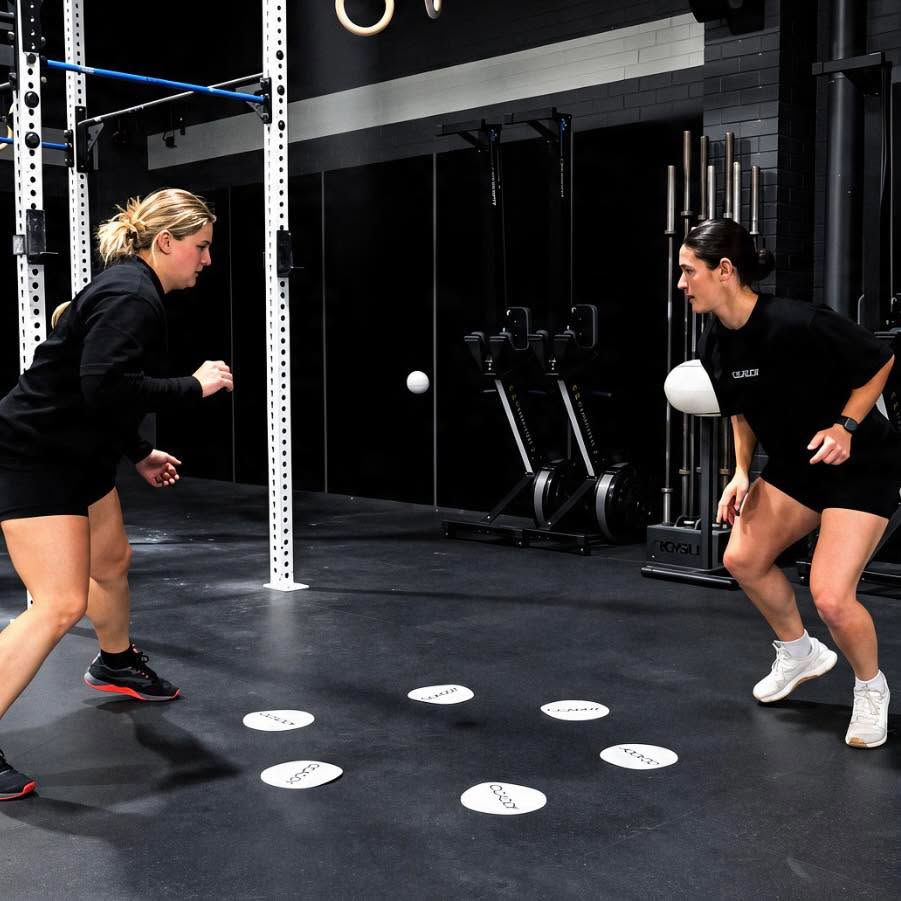
Place four markers around you.
Your partner calls a marker.
React, move towards it and return.
Add a ball once you are comfortable.
10. Seated Ball Reaction
Sit facing a partner.
Have your partner bounce the ball towards either side.
Reach and catch.
This removes running from the drill and places greater emphasis on visual tracking and upper-body coordination.
Why Tennis Players Need Coordination
Tennis involves continual adjustments. The ball doesn't always arrive exactly where expected. Players need to change foot position, adjust their body and time their movement to meet the ball. That is why coordination and reaction training can complement tennis-specific practice.
The ITF's ball-drop conditioning exercise is a good example of how a simple ball can be used to challenge reaction speed and starting ability.
Take Coordination Off the Court
One of the advantages of these drills is that they don't require a tennis court. You can perform many of them in a backyard, park, gym or driveway. That makes coordination training easy to fit into a warm-up, additional training session or short movement break.
The C.CADDY Co-ordination Kit includes balls and markers designed to give athletes simple tools for creating this type of training. For tennis players, that means more opportunities to work on movement, reaction, balance and hand-eye coordination outside traditional hitting sessions.
Want to add another layer to your tennis training? Grab your C.CADDY kit and start training your coordination.